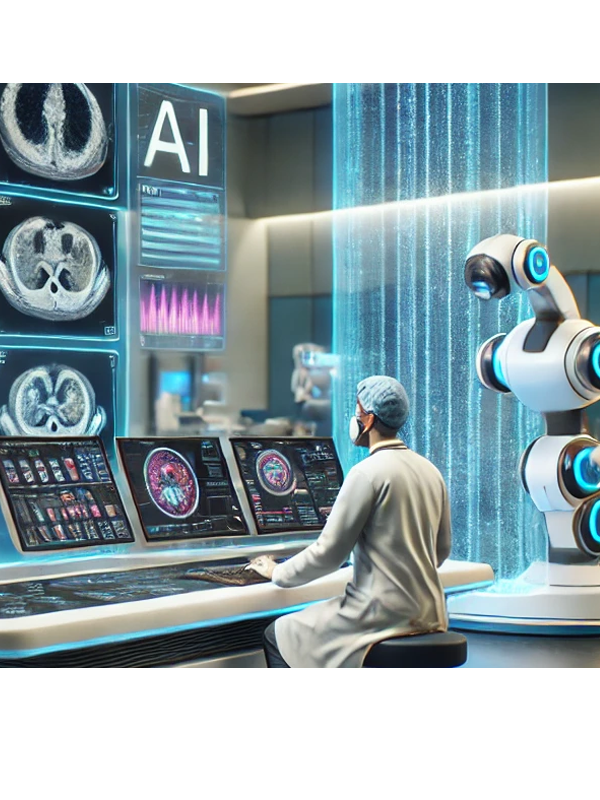
Blog-003 | Date: 11th May 2026
Building the Future of Reflexive Radiology AI
At Layveer Medical Division, we are continuing our mission to combine artificial
intelligence, ethical reflexivity, and clinical decision support into next-generation healthcare
systems.
Following the launch of NeuroWeave: Cognitive Scan, we are now actively developing an
advanced AI-powered chest X-ray analysis platform designed to assist in early radiological
screening and clinical support.
Introducing the Upcoming Layveer X-ray AI Platform
The upcoming system is being designed as a multi-disease radiology assistant capable of
analysing chest X-rays using deep learning and explainable AI techniques.
The platform is currently under development with support for detecting multiple critical chest
conditions, including:
* Pneumonia
* Tuberculosis (TB)
* Pleural Effusion
* Pneumothorax
* Cardiomegaly
* Pulmonary Fibrosis
* Additional thoracic abnormalities in future updates
Unlike traditional binary classifiers, the Layveer platform is being architected as a multi-label
reflexive diagnostic assistant capable of identifying multiple findings within a single
radiograph.
Explainable and Ethical AI
One of the core goals of the project is to move beyond “black-box AI.”
The platform will integrate:
* Explainable heatmap visualization (Grad-CAM)
* Confidence-aware reporting
* Reflexive uncertainty monitoring
* Ethical safety alerts
* Human-review recommendation systems
This aligns closely with our broader research into:
* Intelligence Reflex
* ERIF (Ethical Reflexive Integration Framework)
* ERDI / RECS / BERNI systems
* Human-centered medical AI
Designed for Clinical Assistance — Not Replacement
The system is being developed strictly as an AI-assisted screening and decision-support tool.
It is not intended to replace radiologists or clinicians. Instead, its purpose is to:
* support rapid screening,
* improve workflow efficiency,
* assist educational and research environments,
* and encourage safer human–AI collaboration in medicine.
Current Development Progress
Our development team is currently building:
* DenseNet121-based imaging models
* Multi-disease classification pipelines
* Explainable AI visualization modules
* Backend inference systems
* Reflexive safety architecture
* Mobile and scalable deployment systems
The project is being structured under the Layveer Medical Division research ecosystem and
may eventually expand into:
* CT imaging analysis
* Surgical imaging intelligence
* Reflexive operating-room AI systems
* Real-time medical decision support
Looking Ahead
We believe the future of medical AI will not simply be “accurate AI,” but ethically reflexive
AI capable of recognizing uncertainty, communicating limitations, and supporting clinicians
responsibly.
This project represents another step toward that future.
More updates, demonstrations, and research releases will be shared soon.
Author: Dr. Piush Choudhry Founder, Ethically Reflexive AI in Surgery (ERIF)
Copyright © 2017–2026 Dr. Piush Choudhry / Layveer Medical Division Private Limited.
All Rights Reserved.
Patent Notice: Indian Published Patent No. 202511070784 — Ethically Reflexive Artificial Intelligence in Surgery and High-Risk Human–Machine Tasks.