Blog-007 | Date: 10th July 2026
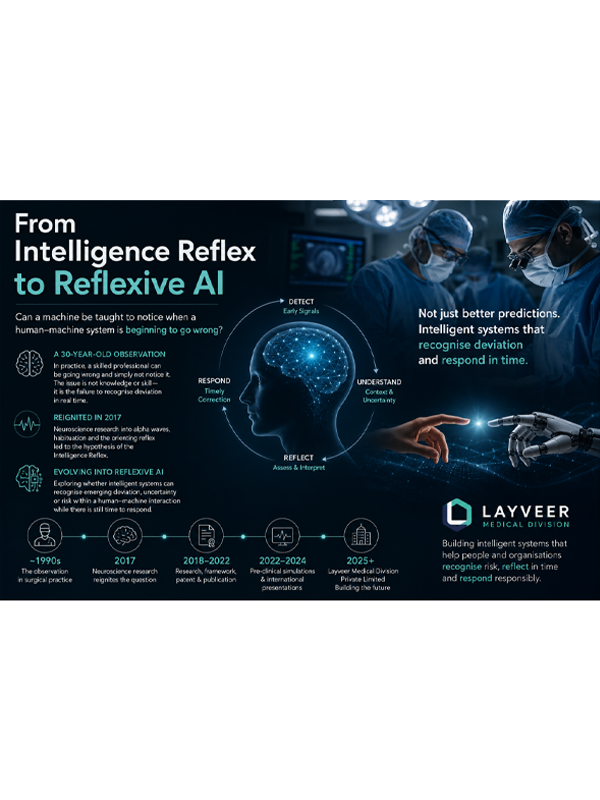
From Intelligence Reflex to Reflexive AI
A 30-year journey from a clinical observation to a broader question about the future of
intelligent human–machine systems.
Can a machine be taught to notice when a human–machine system is beginning to go wrong?
This question is at the heart of our work today at Layveer Medical Division. It is also a question with a
much longer history than our current work in artificial intelligence.
A problem first noticed nearly 30 years ago
Nearly three decades ago, during surgical practice, I was confronted by a simple but troubling
observation: a highly trained professional could be going wrong and simply not notice it.
The problem was not necessarily a lack of knowledge or technical skill. The person might know the
correct method, understand the risks and have years of experience. Yet, in the moment, an action or
situation could begin to move away from its intended course without that deviation being recognised
early enough.
That observation stayed with me because it pointed to something deeper. Expertise is not only the
ability to know what should happen. It may also depend on the ability to recognise, in real time, when
what is happening is no longer what was intended.
Reignited through neuroscience
In 2017, this long-standing question was reignited through my neuroscience research into alpha-wave
activity, habituation and the orienting reflex. The work gave an old clinical observation a new scientific
direction.
It led me to a broader hypothesis: intelligence may not reside only in knowledge, calculation or
prediction. It may also exist in the capacity to recognise meaningful change, detect deviation and initiate
correction.
I called this the Intelligence Reflex.
From a human reflex to Reflexive AI
Today, that idea is evolving into Reflexive AI: an exploration of whether intelligent systems can
recognise emerging deviation, uncertainty or risk within human–machine interactions while there is still
time to respond.
This thinking led to the development of the Ethical Reflexive Integration Framework (ERIF), an
approach that examines how human judgement, machine intelligence and corrective feedback might
work together in real time.
The goal is not simply to build systems that make more predictions. It is to investigate whether an
intelligent system can also recognise when confidence is weakening, context is changing or an
unfolding course is beginning to diverge from what was intended.
The work is moving beyond a single domain
The idea began in surgery, where delayed recognition can have immediate consequences. But the
underlying problem is much larger. Aviation, autonomous systems, industrial operations, healthcare,
critical infrastructure and other high-risk environments all involve moments in which humans and
machines must recognise change before a developing problem becomes an irreversible outcome.
For this reason, our direction is expanding beyond any single sensor, technology or application. We are
exploring behavioural, physiological, contextual and system-level signals that may help intelligent
systems understand not only what is happening, but whether the interaction itself is beginning to move
toward risk.
Building the next phase
The work has progressed through neuroscience research, scientific publication, patent development,
pre-clinical simulation and international surgical presentation. Early simulation findings have been
encouraging and have strengthened our belief that the space between prediction and consequence
deserves much greater scientific attention.
With Layveer Medical Division Private Limited now established, the next phase is focused on
structured validation, stronger engineering capability, academic and innovation partnerships, and
responsible translation.
Recent engagement with the IIT Delhi–IHFC innovation ecosystem has also opened encouraging
possibilities for interaction with researchers, mentors and translational networks as this work develops
further.
A different question for intelligent systems
The next generation of artificial intelligence may not be defined only by how much it knows or how
accurately it predicts.
A more important question may be whether intelligence can recognise when something is beginning to
go wrong—and respond while there is still time to change the outcome.
The idea began in surgery. The problem is much larger.
Author: Dr. Piush Choudhry Founder, Ethically Reflexive AI in Surgery (ERIF)
Copyright: © 2017–2026 Dr. Piush Choudhry / Layveer Medical Division Private Limited. All Rights Reserved.
Patent Notice: Indian Published Patent No. 202511070784 — Ethically Reflexive Artificial Intelligence in Surgery and High-Risk Human–Machine Tasks.
License: All Rights Reserved (no redistribution or commercial use without written permission).