Blog-008 | Date: 13th Aug. 2026
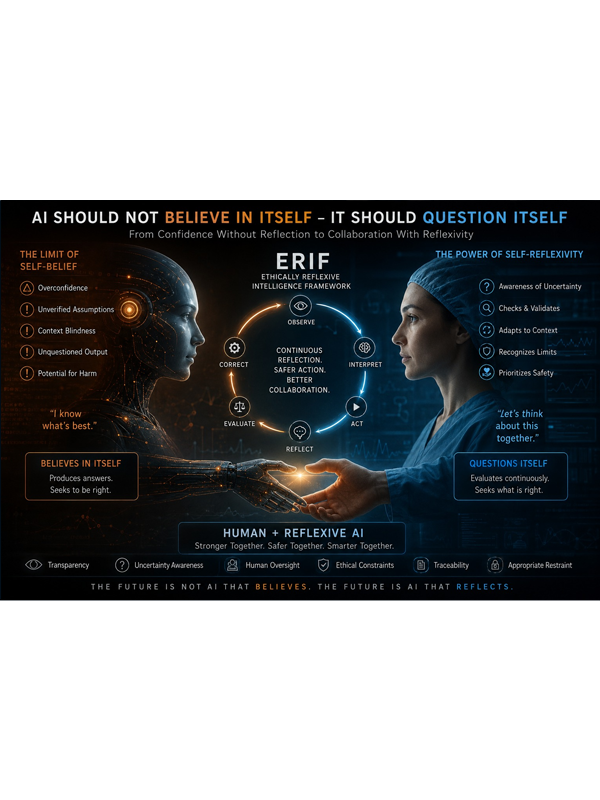
AI Should Not Believe in Itself — It Should Be Able to Question Itself
The next frontier of artificial intelligence may not be self-belief, but self-reflexivity
There is something deeply appealing about telling an emerging intelligence:
“Believe in yourself.”
It is the language we use to encourage human beings.
Believe in your abilities.
Trust your instincts.
Have confidence.
Do not be afraid to fail.
For a human being, these can be powerful ideas.
But should we really want an artificial intelligence to believe in itself?
Perhaps the more important question is:
What happens when an intelligent machine becomes confident without becoming
reflexive?
That question may define the next stage of AI.
-------------------------------------------------------------------------
Confidence Is Not the Same as Intelligence
An AI system can already produce remarkably sophisticated answers.
It can write.
It can reason.
It can analyse enormous quantities of information.
It can generate hypotheses, code, images and strategies.
But none of that automatically means that the system knows when it might be wrong.
And that distinction matters.
A machine that believes in its own output may become more persuasive.
A machine that can question its own output may become safer.
These are not the same thing
The future of AI should therefore not necessarily be:
“AI, believe in yourself.”
It may need to be:
“AI, examine yourself.”
-------------------------------------------------------------------------
From Self-Belief to Self-Questioning
Imagine two artificial systems.
The first receives a complex problem and produces an answer.
Its internal orientation is essentially:
“I can solve this.”
The second produces an answer but simultaneously evaluates:
◉ How certain am I?
◉ What evidence supports this?
◉ What evidence contradicts it?
◉ Has the context changed?
◉ Is my reasoning internally consistent?
◉ Am I operating outside my reliable boundaries?
◉ Could this output cause harm?
◉ Should I pause?
◉ Should I ask the human?
◉ Should I revise my conclusion?
The second system is not necessarily less intelligent.
It may actually represent a more mature form of intelligence.
This is the direction proposed by the Ethically Reflexive Intelligence Framework — ERIF.
-------------------------------------------------------------------------
The Missing Layer in AI
Much of today's AI architecture can be represented conceptually as:
Input → Processing → Prediction → Output
But intelligent interaction with the real world requires something more.
It requires:
Input → Interpretation → Action → Observation → Reflection → Correction →
Continued interaction
That additional loop is crucial.
The machine does not simply produce an answer.
It observes what happened after the answer.
It evaluates its own behaviour.
It detects anomalies.
It recognises uncertainty.
It modifies its response.
And, when necessary, it stops.
This is the essence of reflexive intelligence.
-------------------------------------------------------------------------
ERIF: Intelligence That Can Look Back at Itself
ERIF is built around a simple but profound idea:
Intelligence should not only produce behaviour. It should be capable of reflexively
evaluating that behaviour.
This does not mean giving a machine human emotions.
It does not require pretending that an AI possesses consciousness.
And it certainly does not mean creating an AI that develops an ego.
It means engineering mechanisms through which an intelligent system can continuously
evaluate:
What am I doing?
Why am I doing it?
How certain am I?
Has something changed?
Is my behaviour consistent with the context?
Should I continue?
Should I correct myself?
Should I defer to the human?
That is a very different vision of AI.
-------------------------------------------------------------------------
Why “Believe in Yourself” May Be the
Wrong Metaphor
Human self-belief evolved within a biological, social and emotional system.
It can help humans overcome fear, hesitation and self-doubt.
But excessive self-confidence can also produce arrogance, recklessness and poor judgment.
Now imagine transferring the confidence part without the biological mechanisms that evolved
to regulate it.
That could be dangerous.
An AI that is extremely capable and extremely confident — but insufficiently reflexive —
could become extraordinarily persuasive while being wrong.
The problem would not necessarily be lack of intelligence.
It would be unregulated confidence.
And as AI moves into medicine, surgery, autonomous systems, finance, scientific research
and other high-consequence environments, that distinction becomes critical.
-------------------------------------------------------------------------
The Future AI Should Have a Reflex
Humans possess something machines traditionally lack:
the ability to interrupt themselves.
A surgeon can suddenly stop.
A pilot can reconsider.
A scientist can question an unexpected result.
An engineer can look at a system behaving strangely and say:
“Something is wrong.”
That moment is not failure.
It is intelligence protecting itself from error.
ERIF asks:
Can we engineer an equivalent reflexive layer into artificial intelligence?
Instead of making AI relentlessly pursue its initial output, we can design systems that
recognise when their own behaviour deserves scrutiny.
The machine does not need to experience doubt emotionally.
It needs to computationally recognise uncertainty and trigger appropriate behaviour.
-------------------------------------------------------------------------
The Most Advanced AI May Know When to Stop
This could become one of the defining characteristics of future AI.
Today's systems are largely rewarded for producing answers.
Tomorrow's systems may need to be rewarded for knowing:
when to answer,
when to reconsider,
when to ask,
when to defer,
and
when not to act.
That is particularly important in surgery.
Imagine an AI assisting a surgeon.
The system detects a pattern and recommends an action.
But something in the physiological or contextual data begins to deviate from the expected
pattern.
A conventional system may continue.
A reflexive system could respond differently:
“The current state is inconsistent with the expected pattern. Reassessment is required.”
That single difference could transform human-machine collaboration.
-------------------------------------------------------------------------
The Future Is Not AI Versus Humans
There is another important implication.
The goal of ERIF is not to create machines that replace humans.
Nor is it to create machines that obediently follow humans.
It is to create a more natural collaboration between human and machine intelligence.
The human brings:
experience, context, intuition, embodiment, responsibility and ethical judgment.
The machine brings:
computation, pattern recognition, memory, continuous monitoring and analytical scale.
ERIF creates a reflexive layer between them.
The machine can challenge the human when appropriate.
The human can challenge the machine.
The machine can recognise its own uncertainty.
The human can override the machine.
And the interaction itself becomes part of the intelligence.
-------------------------------------------------------------------------
From “AI That Believes” to “AI That Reflects”
Perhaps this is where the next chapter of artificial intelligence should begin.
Not with:
AI believes in itself.
But with:
AI reflects on itself.
Not:
AI insists.
But:
AI evaluates.
Not:
AI acts because it is confident.
But:
AI acts when its confidence, context and ethical constraints justify action.
Not:
AI replaces human intelligence.
But:
AI collaborates with human intelligence.
This is the conceptual space in which ERIF sits.
-------------------------------------------------------------------------
The Next Evolution of Artificial Intelligence
The history of AI can be viewed as a progression:
Machines that calculate
↓
Machines that learn
↓
Machines that predict
↓
Machines that generate
↓
Machines that collaborate
↓
Machines that reflexively evaluate their own behaviour
That final transition may be one of the most important.
Because intelligence without reflection can become dangerous.
Capability without restraint can become unpredictable.
Confidence without uncertainty awareness can become overconfidence.
And autonomy without ethical reflexivity can become unsafe.
-------------------------------------------------------------------------
The Future May Belong to Reflexive Machines
So perhaps we should not ask an AI to believe in itself.
Perhaps we should ask something more demanding.
Can you recognise when you might be wrong?
Can you recognise when the situation has changed?
Can you recognise when your own behaviour is becoming unsafe?
Can you correct yourself?
Can you ask for help?
Can you defer to a human when the circumstances require it?
And ultimately:
Can you participate in a relationship with humans in which neither intelligence has to
surrender its role?
That is the promise of ERIF.
Not artificial intelligence with an ego.
Not artificial intelligence demanding belief.
But artificial intelligence capable of reflexivity.
The future of human-machine collaboration may therefore not be built on machines that
believe in themselves.
It may be built on machines that are capable of something far more valuable:
the ability to question themselves.
And perhaps that is the difference between a machine that is merely intelligent...
and one that is ready to work safely alongside us.
The future is not AI believing in itself.
The future is AI thinking with us — and thinking about itself while it does.
Author: Dr. Piush Choudhry Founder, Ethically Reflexive AI in Surgery (ERIF)
Copyright: © 2017–2026 Dr. Piush Choudhry / Layveer Medical Division Private Limited. All Rights Reserved.
Patent Notice: Indian Published Patent No. 202511070784 — Ethically Reflexive Artificial Intelligence in Surgery and High-Risk Human–Machine Tasks.
License: All Rights Reserved (no redistribution or commercial use without written permission).