Blog-009 | Date: 01st Sept. 2026
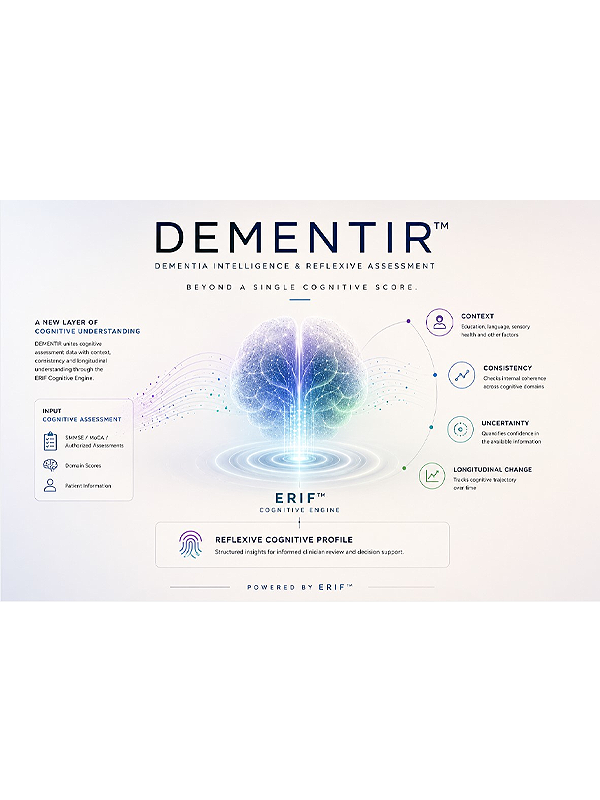
DEMENTIR™: Beyond a Single Cognitive Score
Dementia Intelligence & Reflexive Assessment
Powered by the ERIF™ Cognitive Engine
What if the future of dementia assessment is not simply about measuring cognition—but
understanding how confidently that measurement should be interpreted?
-------------------------------------------------------------------------
A New Layer of Cognitive Understanding
For decades, cognitive assessment has provided clinicians with an important window into
memory, attention, orientation, language and other aspects of cognitive function.
Standardized cognitive assessments can provide a valuable numerical representation of
performance.
But cognition is not a number.
A score is generated within a particular context. Education, language, sensory limitations,
fatigue, clinical circumstances and other factors may influence how an individual performs
during an assessment.
Two people can produce similar scores while displaying very different cognitive patterns.
And sometimes, a single overall score can conceal important differences between individual
cognitive domains.
This leads to a fundamental question:
What if the most important information is not only the score—but how we interpret the
score?
This question is at the heart of DEMENTIR™ — Dementia Intelligence & Reflexive
Assessment, a new cognitive technology initiative being developed by Layveer Medical
Division Private Limited.
-------------------------------------------------------------------------
Beyond a Single Cognitive Score
DEMENTIR is being designed around a simple principle:
Measure cognition. Understand the context. Examine the pattern. Recognize
uncertainty. Reflect before concluding.
At the centre of DEMENTIR is the ERIF™ Cognitive Engine, based on the Ethically
Reflexive Intelligence Framework.
Rather than attempting to replace established cognitive assessments, DEMENTIR is being
developed to add a new interpretive layer around assessment data.
The system is intended to examine:
◉ Cognitive patterns
◉ Domain-level variation
◉ Contextual influences
◉ Internal consistency
◉ Potential sources of bias
◉ Uncertainty
◉ Longitudinal cognitive change
◉ The need for human clinical review
The objective is not simply to generate another number.
The objective is to understand what the available information means—and what it does
not yet tell us.
-------------------------------------------------------------------------
How DEMENTIR Works
The concept is deliberately simple:
Patient → Cognitive Assessment → ERIF™ Cognitive Engine → Reflexive Analysis → Reflexive Cognitive Profile → Clinician Review
The cognitive assessment may come from an appropriately authorized established instrument,
such as SMMSE, MoCA or another validated assessment.
DEMENTIR is not dependent on reproducing any particular assessment instrument.
Its role begins with the information generated by assessment.
-------------------------------------------------------------------------
1. Context: Cognition Does Not Exist in a Vacuum
A cognitive assessment takes place within a human context.
Education may influence performance.
Language may influence comprehension.
Hearing or vision limitations may affect interaction.
Fatigue may affect attention.
Clinical circumstances may alter performance.
These factors do not automatically invalidate an assessment.
But they may influence how its results should be interpreted.
DEMENTIR therefore aims to make contextual information visible within the analytical
process.
The question becomes:
“What circumstances surround this cognitive observation?”
rather than simply:
“What was the score?”
-------------------------------------------------------------------------
2. Consistency: Looking Beneath the Total
A total cognitive score can conceal the distribution of performance underneath it.
DEMENTIR is being designed to examine relationships between available cognitive domains
and identify meaningful variation within the profile.
This is where the ERIF concept of reflexive consistency becomes important.
Instead of stopping at:
Cognitive score = X
the system should progressively be capable of asking:
What pattern produced this result?
Are the available observations coherent?
Are particular domains behaving differently from the overall profile?
Does the information warrant additional clinical consideration?
The intention is not to manufacture a diagnosis from mathematical patterns.
It is to provide the clinician with better structured information for reflection.
-------------------------------------------------------------------------
3. Uncertainty: Knowing What We Don't Know
One of the most important principles behind ERIF is that uncertainty should not be hidden.
Modern AI systems often emphasize confidence:
“The system is 92% confident.”
But confidence without understanding uncertainty can create false reassurance.
“DEMENTIR takes a different conceptual approach.”
It asks:
◉ What information is missing?
◉ How complete is the assessment?
◉ Are the available signals consistent?
◉ Are contextual factors significant?
◉ Could alternative interpretations reasonably exist?
◉ How strongly should the system make a claim?
In other words:
Knowing when not to overstate an interpretation is itself a form of intelligence.
This principle is central to the development of ERIF.
-------------------------------------------------------------------------
4. Longitudinal Cognition: From Snapshot to Trajectory
A single assessment represents one moment.
Cognitive change, however, occurs over time.
DEMENTIR is therefore being designed with a longitudinal perspective.
Instead of viewing:
Assessment 1
as an isolated event, the platform can eventually examine:
Assessment 1 → Assessment 2 → Assessment 3 → Assessment 4
This changes the question from:
“What is the patient's score today?”
to:
“How is the patient's cognitive profile changing over time?”
A trajectory may contain information that a single assessment cannot reveal.
Longitudinal analysis may ultimately become one of the most valuable capabilities of
DEMENTIR.
-------------------------------------------------------------------------
The ERIF Cognitive Engine
The technology underneath DEMENTIR is the ERIF Cognitive Engine.
Our developing architecture includes several conceptual components.
ERDI
Ethically Reflexive Divergence Index
Designed to examine meaningful divergence between relevant cognitive signals or patterns.
RECS
Reflexive Ethical Control Stability
Designed to examine consistency and stability within the interpretive process.
BERNI
A reflexive layer intended to identify potential contextual, systematic or bias-related
influences on interpretation.
Uncertainty Engine
Designed to explicitly account for incomplete information, conflicting signals and limitations
in interpretation.
These components are currently research and development concepts.
They are not being presented as clinically validated biomarkers or diagnostic scores.
That distinction is fundamental to our approach.
-------------------------------------------------------------------------
DEMENTIR Does Not Replace the Clinician
Technology in healthcare should know where its responsibility ends.
DEMENTIR is being developed as a clinical decision-support and research platform.
It is not intended to independently diagnose dementia or Alzheimer's disease.
It is not intended to replace a neurologist, psychiatrist, geriatrician, physician or other
qualified healthcare professional.
Instead, the goal is to provide a richer and more structured information environment for
clinical interpretation.
The philosophy is simple:
AI should strengthen human clinical reasoning—not eliminate it.
-------------------------------------------------------------------------
Designed for Dementia—and Beyond
Dementia represents a broad clinical landscape.
Alzheimer's disease is one of the major causes of dementia, but cognitive impairment can
arise through multiple disease processes and clinical pathways.
DEMENTIR is therefore being developed as a broader cognitive intelligence platform,
rather than an application limited to one disease.
Its potential future architecture could accommodate different assessment instruments, clinical
observations and longitudinal cognitive information.
The underlying ERIF engine remains independent of any single questionnaire.
This gives DEMENTIR room to evolve as research progresses.
-------------------------------------------------------------------------
The Bigger Question Behind DEMENTIR
DEMENTIR is not simply an attempt to build another cognitive-testing application.
The deeper research question is much larger:
Can an AI system become more useful by explicitly examining the limitations of its own
interpretation?
That question lies at the heart of ERIF.
A conventional system may attempt to produce an answer.
A reflexive system should also be capable of asking:
How reliable is this answer?
What might be influencing it?
What information is missing?
Could another interpretation be reasonable?
When should the system defer to human judgement?
This is the conceptual space in which DEMENTIR is being developed.
-------------------------------------------------------------------------
From Measurement to Reflection
The next generation of cognitive technology may not need to replace established cognitive
assessments.
It may need to understand them better.
A score can tell us something.
A pattern can tell us more.
A trajectory can tell us more again.
Dr. Piush Choudhry works at the intersection of surgery, cognitive physiology, artificial
intelligence and human–AI decision support.
And a system capable of explicitly considering context, consistency, uncertainty and its
own limitations may provide an additional layer of intelligence around cognitive assessment.
That is the proposition behind DEMENTIR.
-------------------------------------------------------------------------
DEMENTIR™
Dementia Intelligence & Reflexive Assessment
Beyond a single cognitive score.
Powered by ERIF™
Ethically Reflexive Intelligence for human-centred clinical decision support.
About the Founder
Dr. Piush Choudhry
Founder & Researcher — Layveer Medical Division Private Limited
General Surgeon | Medical AI & Cognitive Intelligence Researcher
Dr. Piush Choudhry works at the intersection of surgery, cognitive physiology, artificial intelligence and human–AI decision support.
Through Layveer Medical Division Private Limited, he is developing research and technology initiatives focused on bringing reflexive, context-aware and responsible intelligence into high-stakes healthcare environments.
His current technology and research initiatives include the development of the ERIF Cognitive Engine, DEMENTIR™, and AI-assisted surgical intelligence systems.
The broader vision is to develop ERIF as a cognitive/reflexive intelligence architecture capable of supporting different high-stakes domains while maintaining transparency, uncertainty awareness and human oversight.
Layveer Medical Division Private Limited
CIN: U86100DL2026PTC468252
Founder: Dr. Piush Choudhry
Website: www.drpiushchoudhry.com
Email: drpiushchoudhry@gmail.com
Reflexive Intelligence. Responsible Innovation.
Intelligence | Physiology | Cognition | Surgery | Care.
A Note on the Current Development Stage.
DEMENTIR is currently a research and development initiative.
The ERIF-derived analytical measures described above are conceptual/prototype components and should not currently be interpreted as clinically validated diagnostic measures. Established cognitive assessments are intended to be incorporated only through appropriate authorization and licensing.
DEMENTIR is designed to support—not replace—qualified clinical judgement.
The vision is simple:
Don't ask only what the score says.
Ask what the score means, what may have influenced it, how certain we are, and what we should do next.
That is DEMENTIR.